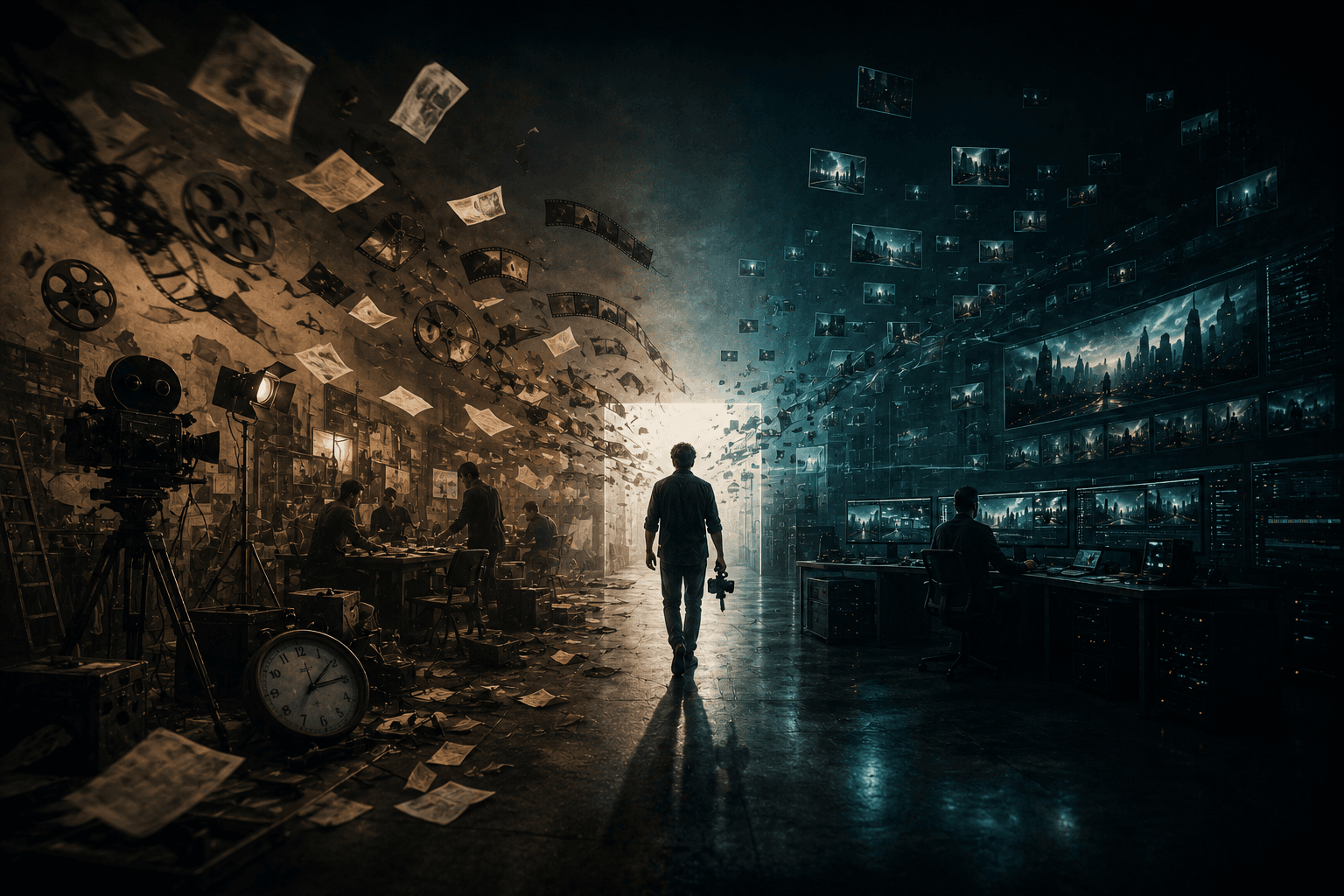
We walked one real brand film brief through both production models, line by line. Around eight weeks became nine to fourteen days, and the craft survived intact. Here is exactly what changed and what did not.
The most common question we get from brands considering their first AI film is also the simplest: how long does this actually take, and what do we give up for the speed? The honest answer needs a comparison, so here is one. Take a sixty-second cinematic brand film: hero location, two cast, product hero shots, full sound design. Same script, same standard, both times. Only the production model changes.
Pre-production: three weeks becomes days
In the traditional model, nothing rolls for about three weeks. Casting calls. Location scouts. Permits. Weather contingencies. Set builds. Every decision is expensive to reverse, so every decision takes a meeting, and the meetings take the calendar.
In the AI-native model, the scout happens on a screen. A world bible locks the look of the film: locations, faces and light are cast from reference sheets in days, not weeks. Because decisions are cheap to reverse, they actually get made instead of deferred. The client sees the film's world before committing to it, which no location scout has ever been able to offer.
The shoot: one unrepeatable window becomes review gates
The traditional shoot is two to three days with thirty or more crew, and the entire budget converges on a window you cannot repeat. Weather, illness, a broken lens: every risk is priced in, because you get one pass at the truth.
In the AI-native model there is no single window. Production runs as generation passes through review gates: shots are generated, reviewed against the world bible, rejected or advanced. Every setup can be re-run. Coverage becomes a decision instead of a gamble, and the pressure moves from the shoot day to the review bar, which is where it always belonged.
Post: the queue shrinks, the humans stay
Traditional post is three to four weeks of edit, grade, VFX and sound, and the queue is the real cost. Every revision re-enters the pipeline at the back.
In the AI-native model, grade and sound remain human crafts, exactly as before. What shrinks is the queue in front of them. A revision is a conversation in the room, not a change order that costs a week.
The total: around eight weeks becomes nine to fourteen days
That range includes the review loops, because a shipped film timeline that excludes revisions is a fiction. It also includes the single biggest structural change in production economics: the reshoot. A reshoot used to be a budget catastrophe that ended careers. It is now a note. The asymmetry that shaped seventy years of production planning, one chance to get it right, is simply gone.
What does not change
The script still has to be good. The direction still has to be deliberate. The performance notes still have to come from someone who knows what the scene owes the audience. And the review bar, the standard a frame has to clear before it ships, has to be enforced by people whose names go in the credits. At Komodo X, every frame is audited by a director's eye before a client ever sees it.
It did not compress the craft. It compressed everything around the craft: the waiting, the queues, the risk premium on decisions that could not be reversed.
What this means for your next brief
Speed is not the real prize. The real prize is what speed makes possible: a film that ships inside the cultural moment it speaks to, more directions explored at the same fee, and a production process where the expensive thing is judgment rather than logistics. If you want this walkthrough run on your own brief, with your numbers, talk to us at komodox.ai.